Explore hs code singapore: A Guide to Classification, Duties & Compliance
When you're moving goods in or out of Singapore, think of the Harmonized System (HS) code as your product's universal passport. This string of numbers is the first thing Singapore Customs looks at to understand exactly what you're shipping – from its material to its purpose. Getting the HS code Singapore right isn't just a […]
When you're moving goods in or out of Singapore, think of the Harmonized System (HS) code as your product's universal passport. This string of numbers is the first thing Singapore Customs looks at to understand exactly what you're shipping – from its material to its purpose.
Getting the HS code Singapore right isn't just a box-ticking exercise; it's fundamental to keeping your logistics smooth, compliant, and cost-effective.
Why HS Codes Are Your Most Important Tool in Singapore Trade
An HS code is like a product's unique fingerprint. It’s a shorthand that gives Singapore Customs all the crucial details they need to process a shipment. This single code determines everything: import duties, taxes, and even whether your goods need special permits or a physical inspection.
Nailing the classification is about more than just filling out forms correctly. It's about speed, cost, and your reputation.
In a hyper-efficient hub like the Port of Singapore, even small delays can cause big problems. A wrong HS code is an instant red flag for customs officials. It can trigger detailed inspections, holds on your shipment, and expensive demurrage fees while everything gets sorted out. For any freight forwarder, that means unhappy clients and a damaged professional relationship.
The Bedrock of Compliance and Efficiency
Correct classification is the absolute foundation of trade compliance. Singapore uses an eight-digit system called the ASEAN Harmonised Tariff Nomenclature (AHTN). It starts with the international six-digit HS standard set by the World Customs Organisation and adds two more digits for specifics relevant to trade within Southeast Asia.
Getting to grips with this system helps you:
- Avoid Expensive Delays: The right code means your shipment breezes through customs checkpoints without unnecessary friction.
- Stay Compliant: Using the correct AHTN code shows you've done your homework and helps you steer clear of some pretty hefty penalties.
- Calculate Costs Accurately: Your HS code is directly tied to the Goods and Services Tax (GST) and any duties owed, which is key for working out a precise landed cost for your client.
In the end, mastering the HS code Singapore framework isn't just a compliance chore—it's a real competitive edge. It allows you to give clients reliable timelines, transparent pricing, and peace of mind. You’re turning a complex customs requirement into a way to build trust and grow your business.
Decoding the 8-Digit Singapore HS Code
At first glance, an 8-digit Singapore HS code can look like just another string of numbers on a customs form. But it’s far from random. Think of it as a product’s universal passport, telling customs officers exactly what it is, what it’s made of, and its function in a language they all understand.
Every digit in this code adds a layer of detail, starting broad and getting progressively more specific. Getting this structure right is the foundation of smooth customs clearance.
The Global Standard: The First Six Digits
The first six digits of any HS code are the global standard, set by the World Customs Organisation (WCO). This means that whether you're shipping a smartphone to Singapore, Germany, or Brazil, the initial classification is the same everywhere. It creates a common language for global trade.
These six digits are broken down into three pairs, each one narrowing down the product's identity:
- Chapter (Digits 1-2): This is the highest-level category. It groups products into broad sectors, like "Machinery and mechanical appliances" (Chapter 84).
- Heading (Digits 3-4): This gets more specific. Within Chapter 84, we might find "Telephone sets, including smartphones" (Heading 8517).
- Subheading (Digits 5-6): This adds another layer of detail, distinguishing between different types of products within the heading. For a smartphone, this might be Subheading 8517.13, specifying "Smartphones".
This hierarchical system flows from the global HS code framework down to the regional AHTN standard, and finally into Singapore's own trade regulations.
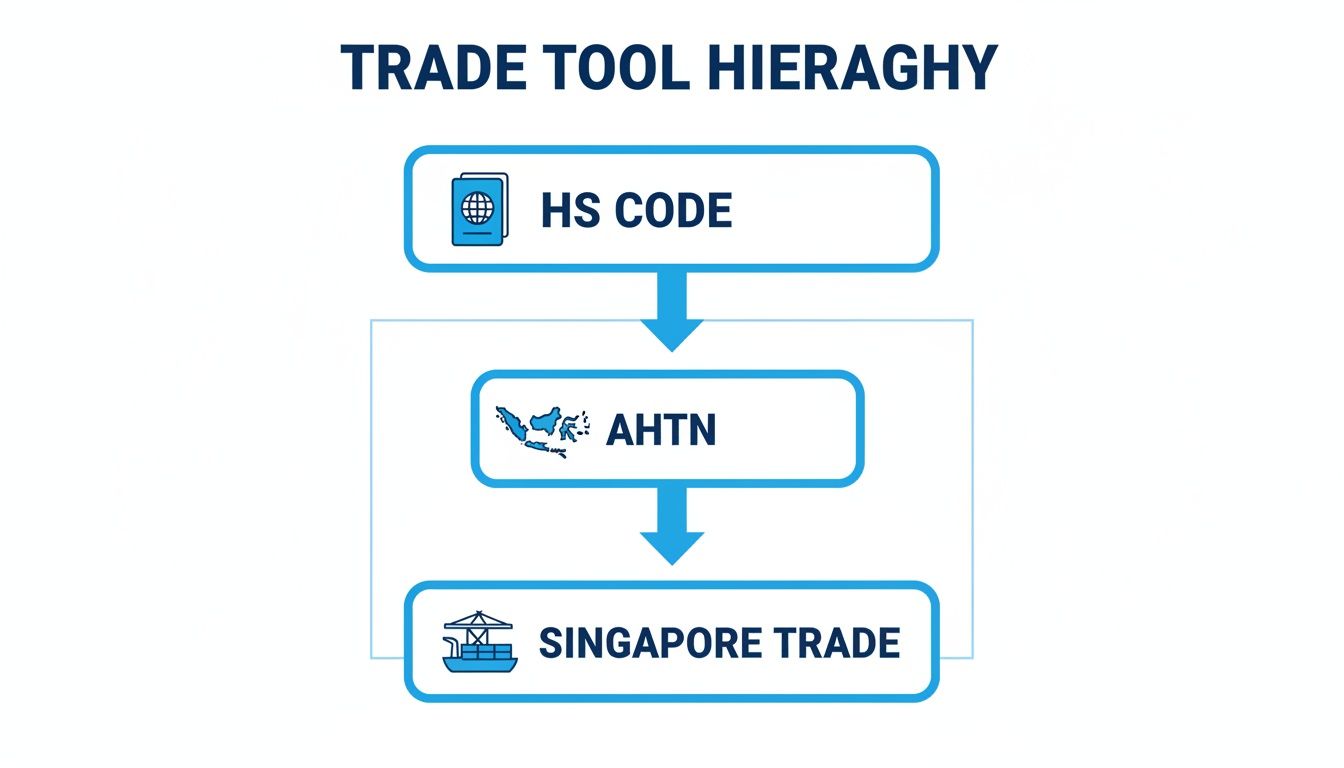
As the diagram shows, the system is designed like a funnel. It starts with a universal standard and refines it for regional and national needs, making trade across ASEAN much more consistent.
The Regional Touch: The Final Two Digits
So what about the last two digits? This is where Singaporean (and ASEAN) specificity comes in. These final digits are determined by the ASEAN Harmonised Tariff Nomenclature (AHTN), a system used across the 10 ASEAN member states.
This AHTN code provides the final, crucial details that Singapore Customs needs to apply the correct duties, Goods and Services Tax (GST), and determine if the product qualifies for preferential treatment under any free trade agreements.
Let’s put it all together. The table below breaks down the anatomy of a full 8-digit Singapore HS code for a smartphone.
Anatomy of an 8-Digit Singapore HS Code
| Code Digits | Level of Classification | Example (e.g., for a Smartphone) |
|---|---|---|
| 85 | Chapter | Machinery and electrical equipment. |
| 8517 | Heading | Telephone sets, including smartphones. |
| 8517.13 | Subheading | Smartphones. |
| 8517.13.00 | AHTN Suffix | The specific code for smartphones under the ASEAN standard. |
This breakdown shows how the code builds a detailed product identity, from a broad industrial category right down to the specific item being shipped. It’s this level of precision that keeps the wheels of international trade turning smoothly.
Singapore's move to the 8-digit AHTN framework has been a game-changer for its logistics sector. Managed by Singapore Customs, this system allows for the precise classification of over 10,000 product categories. For freight forwarders navigating the nation's $1 trillion+ annual merchandise trade, mastering these codes isn't just about compliance—it's about efficiency and competitiveness.
How to Reliably Find the Correct HS Code
Finding the right HS code in Singapore isn't a guessing game. It’s a methodical process that demands precision and the right tools. Your go-to, non-negotiable resource should always be the Singapore Customs' HS/CA Product Code Search engine, which you can find on the GoBusiness portal. This is the definitive source for all classifications.
It's tempting to take a shortcut, maybe by using a code your supplier gave you or one you found on an unofficial website. But that’s a risky move. These sources can easily be outdated or just plain wrong, setting you up for a compliance headache down the road. The GoBusiness portal, on the other hand, is directly updated by Singapore Customs, so you know the information is current and legally sound.
Using the Official GoBusiness Portal
When you're using the search tool, accuracy is everything. Throwing in a vague term like "computer" will spit back hundreds of potential codes, leaving you to sort through the mess. You need to be specific. Think about what makes your product unique—its primary function, what it’s made of, and any distinct features.
So, instead of just searching for "laptop," try something like "portable laptop computer with 14-inch screen." The more detail you provide, the closer you'll get to the correct code on the first try.

The search results will give you the 8-digit AHTN code you need, along with a detailed product description. It will also flag any controlled goods status (CA), which is crucial—it tells you if the item needs a special permit from a Competent Authority before it can be imported or exported.
Advanced Classification Strategies
What about those tricky products? The innovative gadgets or multi-component items where a simple keyword search just doesn't cut it. For these, you need to dig a little deeper.
Here's how seasoned pros tackle it:
- Consult the Explanatory Notes: Singapore Customs publishes extensive explanatory notes that act as the official guide to interpreting the HS code system. These documents are invaluable for understanding the scope and boundaries of each classification.
- Check the Customs Ruling Database: If you’re dealing with a product that's new to the market, chances are someone has been in your shoes before. Search Singapore Customs' database of past classification rulings to see if a precedent has already been set for similar goods.
- Apply for a Formal Ruling: When you need absolute certainty, this is the way to go. You can formally apply to Singapore Customs for an official classification ruling on your product. The decision they provide is legally binding, giving you complete peace of mind and protection from future disputes.
Think of classification like building a legal case. You start with a detailed description of your product (your evidence), use the search tool to identify potential matches, and then back up your choice with the explanatory notes or past rulings. This turns a confusing task into a reliable, repeatable workflow.
For a comprehensive look at the classification process, the official HS Code book and its guiding principles are an excellent resource. Getting comfortable with these official tools is the best way to guarantee every shipment is declared correctly, helping you avoid costly delays and build a solid reputation with clients and customs officials alike.
Avoiding Common HS Code Mistakes and Costly Penalties
It’s easy to think of an HS code as just another number on a form, but a simple mistake here can spiral into a massive headache, both financially and operationally. Misclassifying a product isn't just a clerical error; it’s a fast track to your shipment getting stuck at the port, attracting customs audits, and landing you with some pretty hefty fines.
So, let's move past the theory and look at what actually goes wrong. The most common mistakes are often the simplest. Maybe you relied on an old code from a supplier, or the product description was too vague, or you just weren't sure how to classify an item that does multiple things. These small slip-ups can snowball, eating into your profits and damaging your reputation with clients.
The High Cost of an Error
Let’s be clear: the penalties for getting an HS code Singapore declaration wrong are no joke. Singapore Customs can hit you with a fine of up to S$10,000 for each incorrect entry. Think about a shipment with ten different products, all misclassified. That financial risk adds up incredibly fast, turning what should have been a profitable deal into a serious loss.
And the direct fines are just the beginning. An incorrect HS code often brings a whole host of other problems:
- Costly Delays: Your goods can be held for inspection, racking up demurrage and detention charges that nobody wants to pay.
- Increased Scrutiny: One mistake can put your business on customs' radar. That means more of your future shipments are likely to be pulled aside for a closer look.
- Incorrect GST Payments: Getting the code wrong might mean you've underpaid the Goods and Services Tax (GST). You'll be on the hook for back-payments plus interest, which can really mess with your landed cost calculations.
The world of HS codes is always changing, which makes staying compliant a continuous effort. Just look at the Singapore Customs' HS/CA Search Engine on GoBusiness – it now features over 12,000 codes. What's more, about 15% of those are flagged for specific controls, like strategic goods under HS 98. This just goes to show how critical it is to get your classification right every single time.
Anonymised Case Study: Advanced Batteries
Let me give you a real-world example. A freight forwarder was handling a shipment of advanced lithium-ion batteries. The shipper's paperwork was a bit lazy, just describing them as "power units." The forwarder went with a general code for electrical machinery, which seemed reasonable enough.
The problem? These specific batteries fell under a much more precise HS code, one that classifies them as regulated dangerous goods.
The misclassification triggered an immediate customs hold. The shipment sat at the port for two weeks, the importer was slapped with an S$8,000 penalty for the wrong declaration, and the forwarder's relationship with a very important client was left in tatters.
This story is a perfect illustration of how one small oversight can explode into a full-blown compliance disaster. It also highlights why having clear legal responsibility, which often falls on the Importer of Record, is so critical. It’s a painful but powerful lesson in doing your homework on every single shipment.
Using HS Code Data to Drive Logistics Sales
For most logistics professionals, dealing with HS codes is just part of the job—a compliance hurdle you need to clear to get goods through customs. But what if that data could do more? For a sharp sales team, it's a treasure map.
Instead of casting a wide, hopeful net, you can use customs data to see exactly who is moving the kind of freight you specialise in. It transforms a tedious regulatory detail into a powerful tool for finding your next big client. By digging into this data, you can uncover which companies are importing or exporting specific goods in high volumes, revealing their main trade lanes and what they really do.
Pinpointing High-Value Opportunities
Let’s get practical. Imagine your company excels at temperature-controlled air freight for life sciences. Instead of guessing, you can zero in on companies declaring shipments under HS Chapter 30 (Pharmaceutical Products). Suddenly, you know not just who is in your target market, but also the potential scale of their business.
This simple shift means you stop wasting time and focus your energy where it counts. The same logic works across any sector. A freight forwarder focusing on electronics can build a target list of businesses shipping under HS Chapter 85 (Electrical machinery and equipment), a massive market in Singapore.
It’s about replacing guesswork with real intelligence. You're building a pipeline of pre-qualified leads who have already shown they need exactly what you offer.
Crafting Data-Driven Outreach
Once you’ve identified a company that looks like a perfect fit, you need to find the right person to talk to. This is where a good sales intelligence platform comes in handy. You can take the company's name and quickly find the Logistics Manager or Supply Chain Director, complete with their verified contact details.
Now for the best part: your outreach can be incredibly specific. Forget generic emails. Try something like this:
- For a Tech Importer: "I noticed your company regularly imports integrated circuits under HS Code 8542.31. We specialise in secure air freight for high-value electronics on the Taipei-Singapore lane and know how to get those components here safely and on schedule."
- For a Medical Exporter: "Our data shows you're a key exporter of diagnostic reagents under HS Code 3822.19. We have deep expertise in cold-chain logistics to Europe, ensuring your products maintain full integrity right up to the distributor's door."
Think about the sheer scale. Singapore imported $515 billion in goods. Within that, HS 71 (pearls, precious stones) shot up 45% to $18.5 billion. On the other side, exports under HS 84 (machinery) hit $168 billion, making up 38% of the total—a huge signal for any airfreight forwarder chasing the tech sector. You can explore more of these trade statistics on ASEAN's official data portal.
This level of detail immediately sets you apart. It shows you’ve done your homework and understand their world, positioning you as a problem-solver, not just another salesperson with a pitch.
Platforms with an HS Code filter are built for this kind of targeted prospecting. By understanding a potential client’s actual shipping patterns, you can start conversations that matter, leading to far better response rates and, ultimately, more business.
Nailing HS Codes in Your Daily Workflow
Knowing the theory behind HS codes is one thing, but making it part of your team's muscle memory is what really sets you apart. For freight forwarders and carriers in Singapore, getting the HS code Singapore right every time isn't just about dodging fines; it’s about building a rock-solid reputation for getting things done without a hitch.
A simple yet powerful habit is to build your own internal database of HS codes for the products you handle most often. Think of it as your team's cheat sheet. This little library of verified codes cuts down the research time for repeat shipments, ensures everyone on your team is on the same page, and slashes the risk of simple human error.
Dealing with Vague Descriptions and Missing Details
Let's be honest, not every client sends over perfectly detailed shipping documents. You'll often get product descriptions that are vague, incomplete, or just plain confusing. When that happens, guessing is the worst thing you can do.
Your team needs a clear game plan:
- Create a Standard Operating Procedure (SOP): Make it a hard-and-fast rule: if the description is unclear, you stop. The next step is always to go back to the shipper and ask for more detail. No exceptions.
- Know When to Escalate: Sometimes a product is so new or complex that even with more information, it's a tough call. Your SOP should define this trigger point, where the best advice for your client is to get an official, legally-binding classification ruling directly from Singapore Customs.
For carriers, the HS code is more than just a piece of customs data; it’s a vital part of risk management.
Imagine you're transporting a shipment of chemicals. The HS code tells you instantly if you're dealing with hazardous materials and what special handling is required. This isn't just about compliance—it's about safety, smart resource planning, and ensuring a smooth journey from A to B.
Putting these habits into practice turns HS code classification from a tedious, reactive task into a proactive part of your operation. By having clear rules for tricky situations like vague descriptions, you create a more resilient and efficient workflow. At the end of the day, it's this commitment to getting the details right that clients notice and trust.
Your Top HS Code Questions Answered
Even after you get the hang of HS codes, practical questions always come up in the day-to-day grind. Let's tackle some of the most common ones that logistics pros in Singapore run into. Think of this as your quick-reference guide.
What’s the Difference Between a 6-Digit and an 8-Digit HS Code?
It all comes down to global standards versus regional specifics. The first 6 digits of any HS code are universal. They’re set by the World Customs Organisation (WCO) and mean the same thing whether you’re shipping to New York or Nairobi. It's a global language for product categories.
But Singapore, being part of ASEAN, takes it a step further. We use the ASEAN Harmonised Tariff Nomenclature (AHTN), which adds two more digits to create a more specific 8-digit code. Those last two digits are crucial for our region, helping to pinpoint products for trade policies and tariff calculations right here in Southeast Asia.
Where’s the Official Place to Look Up Singapore HS Codes?
There's only one place you should ever go for this: the Singapore Customs' HS/CA Product Code Search engine. You can find this free tool on the GoBusiness portal, and it's always the most up-to-date and legally recognised source.
Let me be crystal clear here: You must use the official GoBusiness portal. Relying on codes from a supplier or a third-party website is a huge gamble. Those sources are often outdated, and a wrong code can land you in serious trouble. Stick to the single source of truth.
What Happens If I Mess Up and Use the Wrong HS Code?
Using the wrong HS code isn't a minor slip-up; it's a costly mistake that can send ripples through your entire supply chain.
The consequences are real and can hit you hard:
- Gridlock at the Port: The first thing you'll notice is your shipment getting stuck. Customs clearance delays can throw your entire delivery schedule into chaos.
- Unexpected Bills: You could be looking at audits, which often lead to back-paying Goods and Services Tax (GST) and other duties. Suddenly, your carefully calculated landed costs are out the window.
- Serious Fines: Don't forget the legal bite. Singapore Customs can slap you with penalties of up to S$10,000 for every single incorrect declaration. This makes getting the code right less of a 'best practice' and more of a critical risk management task.
Ready to stop prospecting blindly and start engaging high-value shippers? Coreties transforms customs data into your next big client. Find qualified leads and craft data-driven outreach in just a few clicks at https://coreties.com.