Your Guide to Cable HS Code Classification and Leads
Think of a cable HS code as a universal passport for any wire making its way across an international border. Just like a person needs the right travel documents, a shipment needs the right code. Without it, your goods get stuck in customs, racking up expensive delays and potential fines. This simple number is the […]

Think of a cable HS code as a universal passport for any wire making its way across an international border. Just like a person needs the right travel documents, a shipment needs the right code. Without it, your goods get stuck in customs, racking up expensive delays and potential fines.
This simple number is the key to keeping global trade flowing smoothly.
What is the Harmonized System for Cables?
At its heart, the Harmonized System (HS) is the world's trade language, managed by the World Customs Organization (WCO). Picture a gigantic, highly organised library where every product imaginable has its own unique shelf number. The HS code is that number, letting customs officials in Singapore, the United States, and over 200 other countries know exactly what they're looking at in an instant.
This system is non-negotiable for a few big reasons:
- It creates consistency. An insulated copper cable is identified as the same product whether it’s landing in Rotterdam or Rio de Janeiro, eliminating guesswork.
- It ensures fair duty and tax collection. Governments use HS codes to apply the right tariffs. The wrong code can mean you either overpay or underpay, and neither is a good situation.
- It powers global trade data. Nations use this data to track what's coming in and what's going out, which helps them analyse economic trends and form trade policies.
When you're dealing with cables, your main focus will be on Chapter 85 of this "library," which covers all things related to electrical machinery and equipment. The specific "aisle" you'll spend most of your time in is Heading 8544, the home for insulated conductors.
The first six digits of any HS code are the same worldwide. For example, 8544.70 will always point to optical fibre cables. But here’s where it gets a bit more complex: individual countries can add their own digits—two, four, or even six more—to get more specific for their own tariff and tracking purposes. This means a cable's full HS code might be eight, ten, or twelve digits long depending on where it's headed.
For anyone in logistics, getting these codes right isn't just about filling out forms. It’s about making sure shipments move predictably and keeping clients happy. A simple classification error can bring a high-value shipment to a dead stop.
While the shipper usually provides the code, the ultimate legal responsibility for its accuracy falls on the Importer of Record when the goods arrive. This one detail turns a seemingly small administrative task into a critical piece of the supply chain puzzle.
To get a better handle on this crucial role, you can learn more about the Importer of Record's responsibilities here. Understanding this liability shows why mastering HS codes isn't just about avoiding problems—it's about creating a real competitive advantage.
How to Classify Cables Accurately
Figuring out the right HS code for a cable is a bit like identifying a specific model of a car. You can't just call it a 'vehicle' and expect to get the registration right. You need to know the engine size, fuel type, and body style. It's the same with cables—the HS code depends on specific technical details that give it a unique identity for customs.
Trying to guess the cable HS code from a basic description is a surefire way to cause customs delays and rack up unexpected fees. To get it right, you have to look at what the product is actually made of and what it’s designed to do.
This flowchart lays out the basic journey for shipping cables and shows just how essential an HS code is for any international shipment.
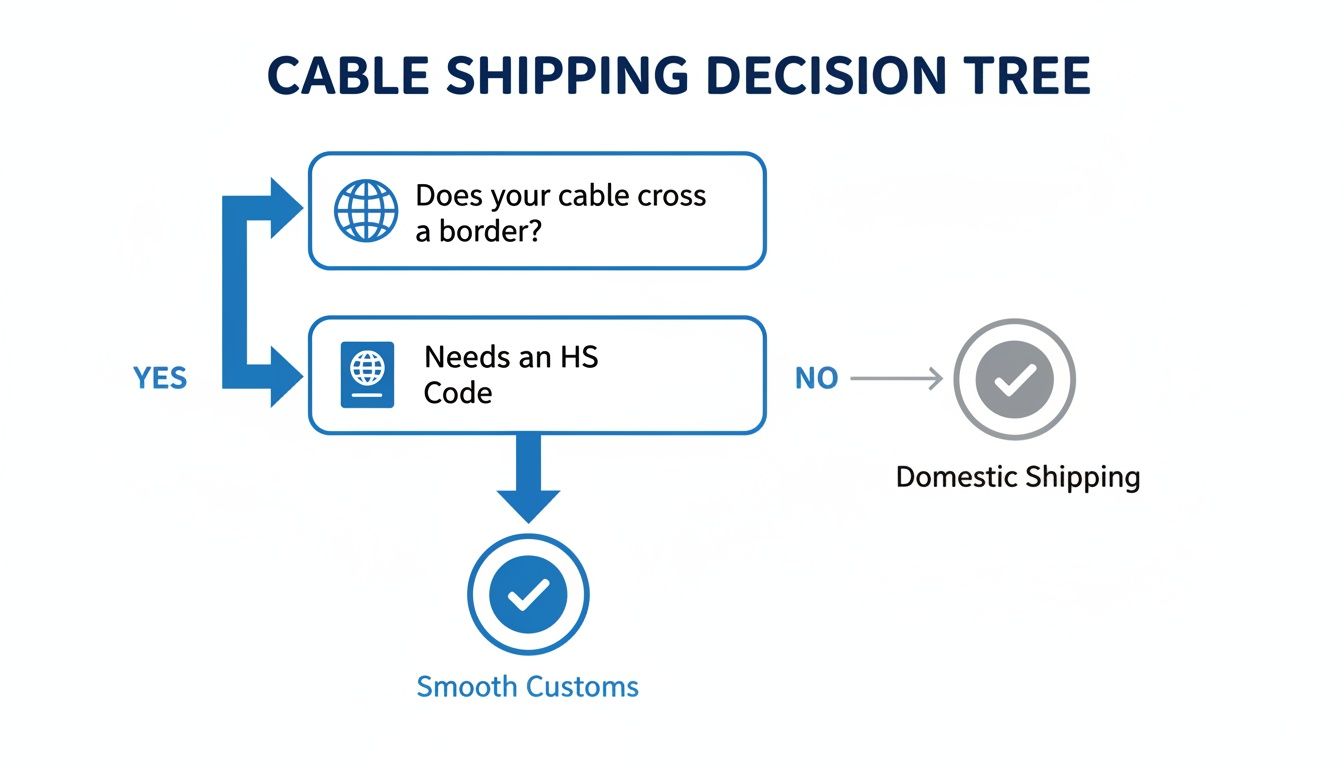
As you can see, the moment a cable crosses a border, a correct HS code becomes non-negotiable. It's the key to a smooth customs process, which is why getting the classification right from the very start is so important.
The Key Classification Factors
For most cables falling under Heading 8544, the classification process comes down to four main technical questions. Think of these as the first things you need to confirm before you can even think about assigning a code.
-
Conductor Material: What's at the core? Is it copper, or another material like aluminium? This is usually the first fork in the road when classifying a cable.
-
Voltage Rating: Is the cable meant for a voltage not exceeding 1000 V, or is it a high-voltage cable rated for over 1000 V? This single detail will send you down completely different classification paths.
-
Insulation Type: The material wrapped around the conductor—be it plastic, rubber, or something else—is another crucial piece of the puzzle that helps narrow down the final digits of the code.
-
Fitted Connectors: Does the cable have connectors attached right out of the box? Cables that are ready to use, like an Ethernet or USB cable, are classified differently than a massive spool of bulk cable.
Once you have the answers to these questions, you’ve built the foundation for finding the correct six-digit HS code. From there, you can dig deeper to find the specific national tariff codes for the destination country. For a closer look at how this works in our region, our guide on the Singapore customs HS code system is a great resource.
Using the General Interpretative Rules
But what about tricky situations? What if you're dealing with a hybrid cable that has multiple materials or functions? This is where the General Interpretative Rules (GIRs) become your best friend. The GIRs are the official "rulebook" for customs classification, giving everyone a consistent framework to work through ambiguities.
The GIRs aren't just suggestions; they are the binding principles customs officials rely on to make their final decisions. For complex products, GIR 3 is often the most critical rule, as it helps determine the "essential character" of an item.
Let's take a practical example: a cable assembly containing both copper wires for power and optical fibres for data. Where does it belong?
- GIR 3(a) tells you to start with the most specific heading available.
- GIR 3(b) guides you to classify the product based on the component that defines its essential character.
- GIR 3(c) is the last resort: if all else fails, you classify it under the heading that appears last in numerical order.
For our hybrid cable, you'd have to decide what its main purpose is. If it’s primarily a data cable that happens to carry a small amount of power, its essential character is data transmission. In that case, you'd likely classify it under the optical fibre heading (8544.70).
By working through these factors and rules step-by-step, you create a logical and defensible argument for your chosen cable HS code. This systematic approach turns a confusing task into a clear, repeatable process, giving you the confidence to manage shipments and ensure total compliance.
Common HS Codes for Different Cable Types
Trying to memorise every HS code is a lost cause. The real trick is knowing where to look. For cables, nearly everything you'll encounter falls under a single master heading: 8544, which covers insulated wires and cables. Think of it as the main street for all things cable-related.
From there, the specific "address" or code depends on the cable's construction and what it's built to do. Knowing these common groupings turns a frantic search into a simple process of elimination. It’s the difference between guessing and making an informed decision, which helps you spot errors and advise clients like a true expert.
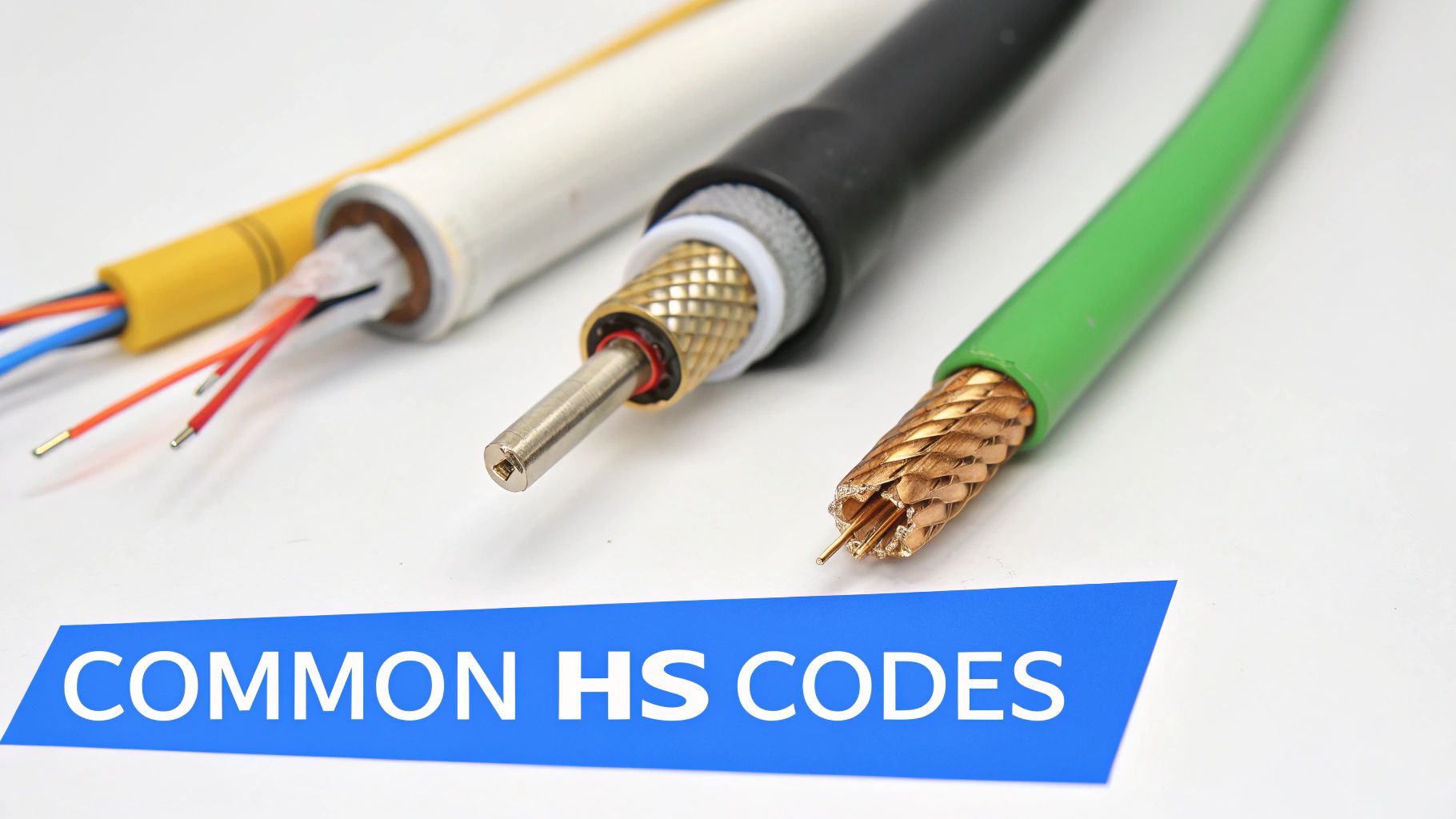
Core Electrical and Insulated Conductors
The bread and butter of the cable world are your standard insulated conductors for power and general wiring. These are the workhorses, and their classification hinges on two simple questions: What’s the voltage, and does it have connectors?
Most of your day-to-day shipments will land in one of these subheadings:
- HS Code 8544.42 is your go-to for insulated conductors rated for 1000V or less that are already fitted with connectors. We’re talking about everyday items like appliance power cords, USB cables, and ready-to-use Ethernet patch cords.
- HS Code 8544.49 covers the exact same conductors (≤1000V) but without connectors. Picture big spools of electrical wire destined for building sites or manufacturing lines—that's where this code comes in.
- HS Code 8544.60 is reserved for the heavy hitters: conductors built to handle voltages over 1000V. These are your high-voltage cables for power grids and serious industrial machinery.
That tiny distinction between 8544.42 and 8544.49—the presence of a connector—is probably one of the most frequent mix-ups in cable classification. It's a small detail with big implications.
Specialised Communication Cables
Once we move beyond simple power, we get into cables designed for communication. Here, the technology used to send the signal becomes the deciding factor, not just the voltage or metal inside.
A cable's function is often its defining characteristic in the eyes of customs. A coaxial cable and a fibre optic cable might both transmit data, but their fundamental construction is so different that they are placed in entirely separate subheadings.
This is the neighbourhood for more high-tech cables:
- HS Code 8544.20 Coaxial Cables: This is the specific home for coaxial cables. Their unique shielded design is critical for keeping signals clean in cable TV and internet applications, earning them their own distinct category.
- HS Code 8544.70 Optical Fibre Cables: Cables that send data as pulses of light belong here. This code covers everything from single strands to massive bundles of individually sheathed fibres, whether they include electrical conductors or have connectors attached. Given their high value, getting this code right is especially important.
Assembled and Automotive Wiring
Finally, we have a major category for complex cable assemblies, particularly those designed for the automotive and aviation industries. These aren't just wires; they are intricate, purpose-built systems.
- HS Code 8544.30 Ignition Wiring Sets: This subheading is reserved for wiring sets used in vehicles, aircraft, or ships. You'll often hear them called "wiring harnesses." They're pre-assembled bundles of various wires and connectors designed to distribute power and signals throughout an engine or electrical system.
To make things even easier, here's a quick cheat sheet covering these common codes.
Quick Reference Guide to Common Cable HS Codes
This table breaks down the main HS code subheadings for the most frequently shipped cable types, highlighting the key details that determine their classification.
| Cable Type | Primary HS Code Heading/Subheading | Key Classification Factors |
|---|---|---|
| Insulated Wire with Connectors | 8544.42 | Voltage (≤1000V), presence of connectors |
| Insulated Wire without Connectors | 8544.49 | Voltage (≤1000V), absence of connectors |
| High-Voltage Conductors | 8544.60 | Voltage exceeding 1000V |
| Coaxial Cable | 8544.20 | Shielded coaxial construction for signal integrity |
| Optical Fibre Cable | 8544.70 | Made of individually sheathed glass or plastic fibres |
| Automotive Wiring Harness | 8544.30 | Pre-assembled sets for use in vehicles, aircraft, or ships |
Getting comfortable with these common cable HS code groups gives you a solid foundation. You'll be able to handle the majority of shipments you see with greater speed and far less risk of compliance headaches.
A Simple Checklist to Nail Your Cable Classification
Getting your cable's HS code right isn't about guesswork; it's about having a solid, repeatable process. Winging it can lead to expensive customs delays and frustrated clients, but a systematic approach makes sure you're accurate every single time.
Think of these four steps as your pre-flight check before any shipment leaves the warehouse. Each step builds on the last, helping you narrow down the possibilities until you land on the one correct code. This framework takes the ambiguity out of classification and gives you a defensible reason for the code you've chosen.
1. Start with the Technical Specs
Before you even glance at a tariff schedule, you have to know exactly what you’re dealing with. A vague description like "electrical cable" won't cut it. You need to get your hands on the technical data sheet and dig into the nitty-gritty details.
Your first job is to answer a few core questions:
- What's the conductor made of? Copper? Aluminium? This is often the first major fork in the road within Heading 8544.
- What's the voltage rating? Is it for use at 1,000V or less, or is it a high-voltage cable? This single detail can send you to completely different subheadings.
- Does it have connectors? Is it a finished cable, ready to plug in, or is it just a bulk reel of wire? This seemingly small point is a massive differentiator in customs terms.
- Is it a special type? Are you looking at a coaxial cable or one made of optical fibres? These specialised cables have their own dedicated HS codes.
Trying to classify a cable without this information is like navigating blind. Always push for a detailed spec sheet from the manufacturer or shipper.
2. Figure Out the Cable's End Use
Once you know what the cable is, you need to understand what it does. The cable’s final application often provides the missing piece of the puzzle, especially when you’re dealing with complex or composite products. This is where you look beyond the raw specs to see its main purpose.
For example, is the cable part of an ignition wiring set for a vehicle? If so, it falls squarely under subheading 8544.30, no matter what the individual wires are made of. In this case, its specific end-use as an automotive part overrides a more general classification.
Think about a hybrid cable that has both copper conductors for power and optical fibres for data. The crucial question here is: what gives the cable its "essential character"? If its main job is high-speed data transmission with power as a secondary feature, its end-use points you toward classifying it as a fibre optic cable under 8544.70.
Analysing the end-use stops you from making the mistake of classifying a product based on just one of its components.
3. Dive into the Official Tariff Notes
Okay, you've got your technical data and you understand the end-use. Now it's time to open up the official Harmonized Tariff Schedule (HTS). But don't just hunt for a code that looks right—you need to read the fine print. The Chapter and Section notes at the start of each section are legally binding and offer critical guidance.
These notes are packed with definitions, exclusions, and rules that can completely change your final classification. For instance, the notes for Chapter 85 will tell you exactly what "fitted with connectors" means or clarify how to treat cable assemblies. Skipping these notes is one of the most common—and costly—mistakes you can make.
4. Check for Country-Specific Nuances
The first six digits of an HS code are the same worldwide, but that's only half the story. Most countries add their own digits to create more detailed national tariff lines. This final check is absolutely essential for staying compliant in the destination country. A six-digit code is almost never enough.
Take the GCC nations, for instance. Their upcoming switch to 12-digit HS codes from 1 January 2025 is a huge deal for cable exporters. Getting it wrong could lead to massive duty hikes of 20-30%. For Singaporean exporters and regional suppliers, a simple documentation error can quickly become a major financial headache. You can learn more about how these HS code updates impact cable shipments from FreightAmigo.com. This just goes to show why you must always verify the full, country-specific HS code before you ship.
Turning HS Code Knowledge into Shipper Leads
Getting a handle on the technical side of cable HS codes is a fantastic skill for staying compliant. But what if you could spin that expertise into a goldmine of high-quality shipper leads? This is the point where customs data stops being a bureaucratic headache and becomes one of your sharpest sales tools.
Forget casting a wide, inefficient net with generic business directories or cold calls. By using the specific cable HS code a company ships under, you can zero in on them as a perfect-fit prospect. This flips your sales process on its head—you’re no longer guessing who needs your services, you’re engaging potential clients you know are a match.
This screenshot from Coreties gives you a glimpse of how a modern data platform can transform raw customs information into a clean, actionable list of potential clients.

What you're seeing is the translation of complex bill of lading data into clear company profiles, making it incredibly easy to see who is shipping what, where they're sending it, and how often.
Pinpointing Your Ideal Prospects with HS Code Searches
Let's get practical. Say your company is an expert at handling insulated electrical wiring. You know everything about shipping spools of cable that fall under HS code 8544.49. Instead of vaguely searching for "electronics manufacturers," you can jump onto a customs data platform and search for every single company actively exporting or importing goods under that exact code.
This simple step instantly weeds out all the irrelevant businesses, leaving you with a clean list of active shippers who desperately need your specific skills. The process is refreshingly straightforward:
- Plug in the Target HS Code: Start by typing in the precise cable HS code you're after, like
8544.49for insulated wiring or8544.70for optical fibre cables. - Filter by Geography: Next, narrow down the results. Are you looking for exporters based in Singapore or importers in Vietnam? You can target the specific trade lanes that matter most to your business.
- Analyse the Activity: Look at the shipment data to gauge volume and frequency. A company with consistent, high-volume shipments is a much hotter lead than one with a single, tiny transaction on its record.
This focused approach means your sales team can stop wasting time and start talking directly to businesses that are already qualified. You know they ship the products you handle, operate in your target lanes, and have a genuine, ongoing need for logistics services.
Building a Hyper-Targeted Prospect List
Once you have a list of companies shipping under your target cable HS code, you can start building a truly powerful prospect list. Modern lead discovery platforms give you so much more than just a company name; they deliver a full-blown profile of the business and its key decision-makers.
The real magic of this data isn't just finding names; it's about informing your entire approach. You can craft messages that reference a prospect's actual shipping activity, proving from the very first sentence that you've done your homework and understand their business.
For example, Singapore’s cable manufacturing sector is a powerhouse in the region. One company, Singapore Cables Manufacturers (Pte) Ltd, exported USD 6.28 million under HS code 8544.49 alone—that's over half of its entire cable export portfolio. Knowing this nugget of information allows a sales team to immediately flag them as a high-value prospect and kick off a conversation focused on their biggest export category.
Crafting Outreach That Actually Works
Armed with this level of detail, cold calling becomes a relic of the past. Your outreach can be personal, relevant, and impossible to ignore. You can connect with the right person—whether it’s a logistics manager or the head of procurement—and start a conversation that delivers value from the get-go.
Imagine sending an opening email this specific:
"Hi [Name], I noticed your company's recent shipments of insulated wiring under HS code 8544.49 from Singapore to Australia. We specialise in this lane and have helped similar cable exporters reduce their transit times by up to two days."
This data-driven approach immediately positions you as an informed expert who solves real-world logistics problems, not just another salesperson with a generic pitch. For logistics teams looking to make this strategy a core part of their growth engine, our guide on leveraging EXIM data for manufacturing enterprise leads offers a much deeper dive. By using cable HS code data, you can turn compliance know-how into a predictable stream of new business.
Got Questions About Cable HS Codes? Let's Untangle Them.
Even with the best process, you're bound to run into some tricky classification scenarios. It just comes with the territory. Knowing how to handle these common challenges is what separates the pros from the rest, helping you give solid advice and prevent those dreaded, costly delays at the border.
Getting these details right isn't just about compliance; it's about building trust and proving you’re the reliable logistics partner your clients need. Let's dive into some of the most common classification headaches you’ll likely face.
What if a Cable Assembly Has Different Connectors on Each End?
This is a classic puzzle we see all the time. Picture a cable with a standard USB plug on one end and a unique, proprietary connector on the other, designed for a specific piece of industrial machinery. Where does it belong?
The secret is in General Interpretative Rule 3(b). This rule tells us to classify the item based on what gives it its "essential character". You have to ask yourself: what is this cable really for? Is it just a generic data cable that happens to have a weird plug, or is it a purpose-built part for that specific machine? If its main job is to connect to that machine, then the proprietary end defines its essential character, not the common USB port.
Why Does the Same Cable Seem to Have Different HS Codes?
Ever notice that what looks like the exact same cable gets a different HS code in the US versus, say, a country in the GCC? Maybe it's a 10-digit code for one and a 12-digit code for another. This is perfectly normal, and it's a critical detail to understand.
The World Customs Organisation (WCO) standardises the first six digits of an HS code globally. That part is the same everywhere. But individual countries can tack on extra digits to get more specific for their own national tariffs and data collection.
The six-digit "root" code is for global consistency, but those extra country-specific digits are what actually determine the duties and taxes owed. Always check the full national tariff code for the destination country.
This is exactly why you can't stop at the first six digits. A simple six-digit code is almost never enough for a customs declaration. You have to drill down to the specific code for the importing nation to avoid misclassification penalties.
What’s the Single Biggest Mistake People Make?
If there's one mistake we see over and over, it's mixing up HS Code 8544.42 (conductors fitted with connectors) and HS Code 8544.49 (conductors not fitted with connectors). It sounds so simple, but it trips people up constantly.
Think of it this way: a simple power cord with plugs on the ends, ready to be used right out of the box, belongs in 8544.42. But a massive spool of bulk electrical wire meant for an electrician to cut and install falls under 8544.49.
It might seem like a tiny detail, but it has a huge impact on duties and how smoothly a shipment clears customs. Forgetting to check for a connector is an easy slip-up that can cause incorrect declarations, shipment holds, and a very unhappy client dealing with unexpected costs.
Stop guessing and start targeting the right shipper leads. Coreties transforms global trade data into an actionable prospecting tool, allowing you to find companies shipping specific cable types and reach out with compelling, data-driven insights. Discover your next high-value client with Coreties today.