The Ultimate Guide to HS Code for Shoes Classification
You won't find one single HS code for shoes. Instead, every pair of shoes gets classified under Chapter 64 of the Harmonized System, and the right code depends on a few specific details. The classification almost always comes down to the material used for the shoe's upper and its outer sole—think leather, textiles, or rubber. […]
You won't find one single HS code for shoes. Instead, every pair of shoes gets classified under Chapter 64 of the Harmonized System, and the right code depends on a few specific details. The classification almost always comes down to the material used for the shoe's upper and its outer sole—think leather, textiles, or rubber.
Decoding the HS Code System for Footwear
The Harmonized System (HS) is the global standard for classifying products moving across borders. It’s essentially a universal language for customs, making sure a pair of leather boots is understood the same way in Singapore as it is in Switzerland. For footwear, thankfully, everything is neatly organised into one place.
All footwear classifications live within Chapter 64 of the HS tariff schedule. This chapter covers everything from waterproof wellingtons and elegant leather loafers to individual parts like insoles and uppers. Getting the code right isn't just a box-ticking exercise; it directly affects the duties and taxes paid, and how quickly your shipment clears customs.
The Two Golden Rules of Shoe Classification
When you're trying to pin down the right HS code for a pair of shoes, it all boils down to two key questions:
- What's the upper made of? This is the part of the shoe covering the top of your foot. The material that makes up the largest external surface area—whether it’s leather, canvas, or plastic—is the first major deciding factor.
- What's the outer sole made of? This is the bit that hits the pavement. The material here—rubber, plastic, leather, or even textile—is the second piece of the puzzle.
Here's a quick reference to keep these factors top of mind:
Key Determinants for Shoe HS Code Classification
This table summarises the primary factors that customs officials look at when classifying footwear under the Harmonized System.
| Classification Factor | Description | Example Impact |
|---|---|---|
| Upper Material | The material with the largest external surface area on the part of the shoe above the sole. | A shoe with a textile upper will fall under a different heading (e.g., 6404) than one with a leather upper (6403). |
| Outer Sole Material | The material of the sole that makes direct contact with the ground. | A rubber or plastic outer sole is a primary distinction for headings 6401, 6402, and 6404. |
| Specific Features | Special characteristics like being waterproof, having a protective metal toe-cap, or covering the ankle. | Waterproof footwear is often classified under heading 6401, regardless of the upper material in some cases. |
| Intended Wearer | Some classifications make distinctions for men's, women's, or children's footwear. | This is usually a subheading distinction that can affect duty rates. |
Understanding these determinants is crucial because a small difference in material can shift a shoe into a completely different HS heading, potentially changing the tariff significantly.
For freight forwarders and shippers, getting this right is non-negotiable. A mistake can lead to expensive delays, fines, and unhappy clients. Knowing the ins and outs of Chapter 64 is especially important for navigating specific trade lanes. For instance, in 2023, Singapore was the 36th largest global footwear exporter, a small but important player in the market. You can dig deeper into Singapore's global footwear trade statistics on OEC.world.
One of the most common pitfalls is classifying a shoe by its style instead of its materials. "Sneaker" isn't a classification category. The correct HS code depends on what it's made of. If the upper is textile, it likely belongs in heading 6404. If it's plastic, it probably falls under 6402. This distinction is the bedrock of an accurate customs declaration.
Classifying Shoes by Upper and Outer Sole Materials
When you're trying to find the right HS code for a pair of shoes, it all boils down to two key parts: the upper and the outer sole. Get these right, and you’ve laid the groundwork for an accurate classification. These components are what customs officials look at first to decide which primary heading in Chapter 64 your footwear belongs to.
The upper is simply the part that covers the top, sides, and back of your foot. The outer sole, as the name suggests, is the part that hits the ground. Everything else is secondary to these two elements.
This decision tree gives you a great visual starting point, breaking down the process based on the two most critical components of any shoe.
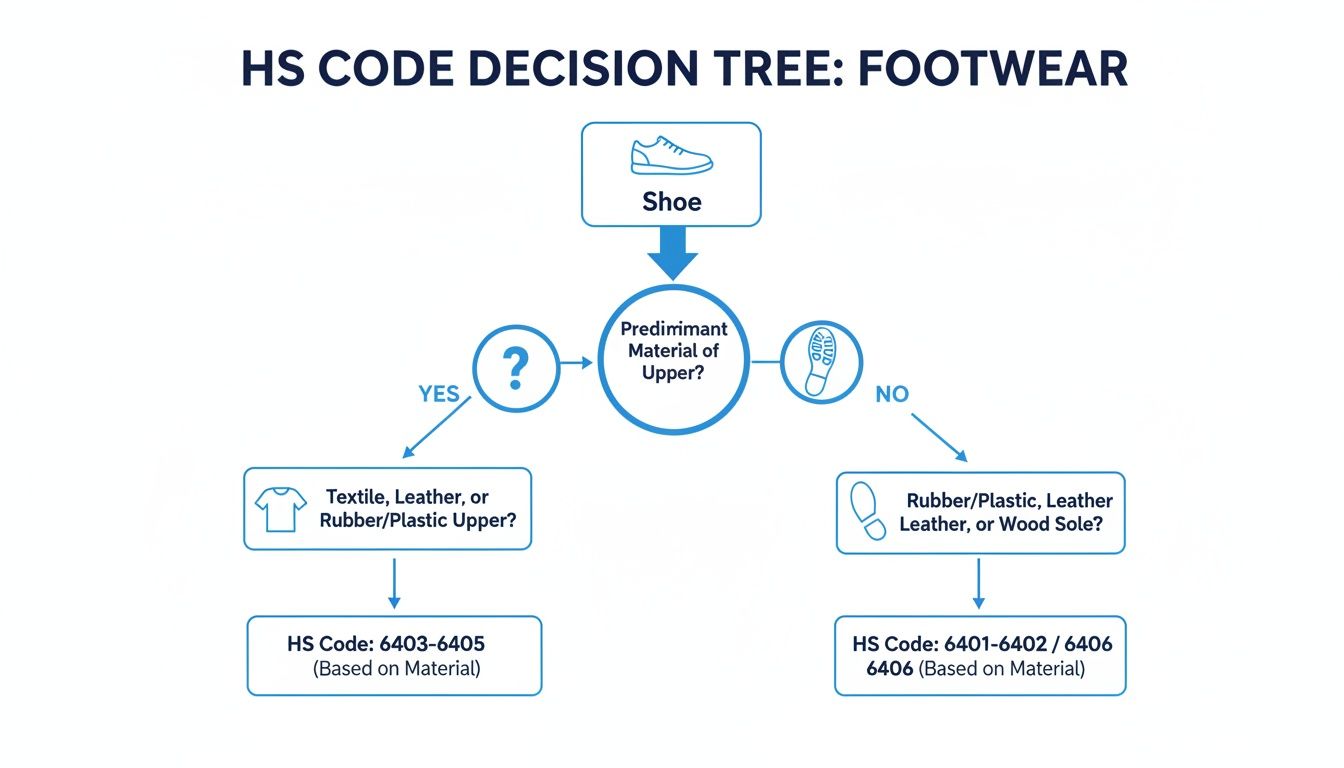
As you can see, the first question is always about the upper's material, followed immediately by the outer sole. This simple path will guide you straight to the correct HS heading.
Footwear with Rubber or Plastic Uppers
If the upper is made mostly of rubber or plastics, you're looking at HS Heading 6402. This is a massive category, covering everything from everyday trainers to heavy-duty work boots.
- Example 1: Think of a pair of synthetic running shoes. They have a plastic mesh upper and a rubber sole, which puts them squarely in this heading.
- Example 2: Even a basic pair of rubber flip-flops falls under 6402 because of their simple material makeup.
The rule here is straightforward: for heading 6402 to apply, both the outer sole and the upper must be made of rubber or plastics.
Footwear with Leather Uppers
Shoes with a leather upper belong under HS Heading 6403. This heading is for any and all footwear with leather uppers, no matter what the outer sole is made from—be it rubber, plastic, or even more leather.
A very common mistake is to classify a shoe with a leather upper based on its rubber sole. The rules for Chapter 64 are clear: the leather upper takes priority. Getting this detail right is crucial for avoiding expensive delays and penalties at customs.
For example, a classic pair of men's brogues with a polished leather upper and a sturdy rubber sole is correctly classified under Heading 6403. The leather dictates the code.
Footwear with Textile Uppers
When the upper is made from textiles—like canvas, cotton, or synthetic fabrics—the classification shifts to HS Heading 6404. This is the home of countless casual shoes, from espadrilles to classic canvas trainers.
But there's a catch. This heading only applies if the outer sole is made of rubber, plastics, leather, or composition leather.
- Example: A pair of canvas plimsolls with a textile upper and a vulcanised rubber sole is a textbook case for Heading 6404.
If a shoe has a textile upper but its sole is made from something else, like the plaited rope on a traditional espadrille, it gets bumped into a different category entirely.
The Essential Character Rule for Mixed Materials
Let's be realistic—many modern shoes are a mix of materials. You'll often see leather combined with mesh panels or other fabrics. When faced with a hybrid design, you need to apply the "essential character" rule, which comes from the General Rules of Interpretation (GRIs).
To do this, you determine which material covers the greatest external surface area of the upper. It's important to ignore accessories or small reinforcements like ankle patches, logos, or eyelet stays during this assessment. This rule provides a consistent way to classify complex footwear, bringing clarity to even the most innovative designs.
Classifying Specialised Footwear and Components
Once you move past everyday shoes, the classification system gets a lot more specific. It has dedicated headings for specialised footwear and even for individual shoe parts. For any logistics professional dealing with diverse cargo—from high-performance athletic gear to raw materials for a factory—getting these distinct categories right is crucial. A mistake here can be just as costly as misclassifying a standard pair of shoes.
The main categories you need to keep a close eye on are waterproof footwear, certain types of sports footwear, and components that are shipped separately. Each of these has its own unique criteria that will actually override the general material-based rules we've already covered.
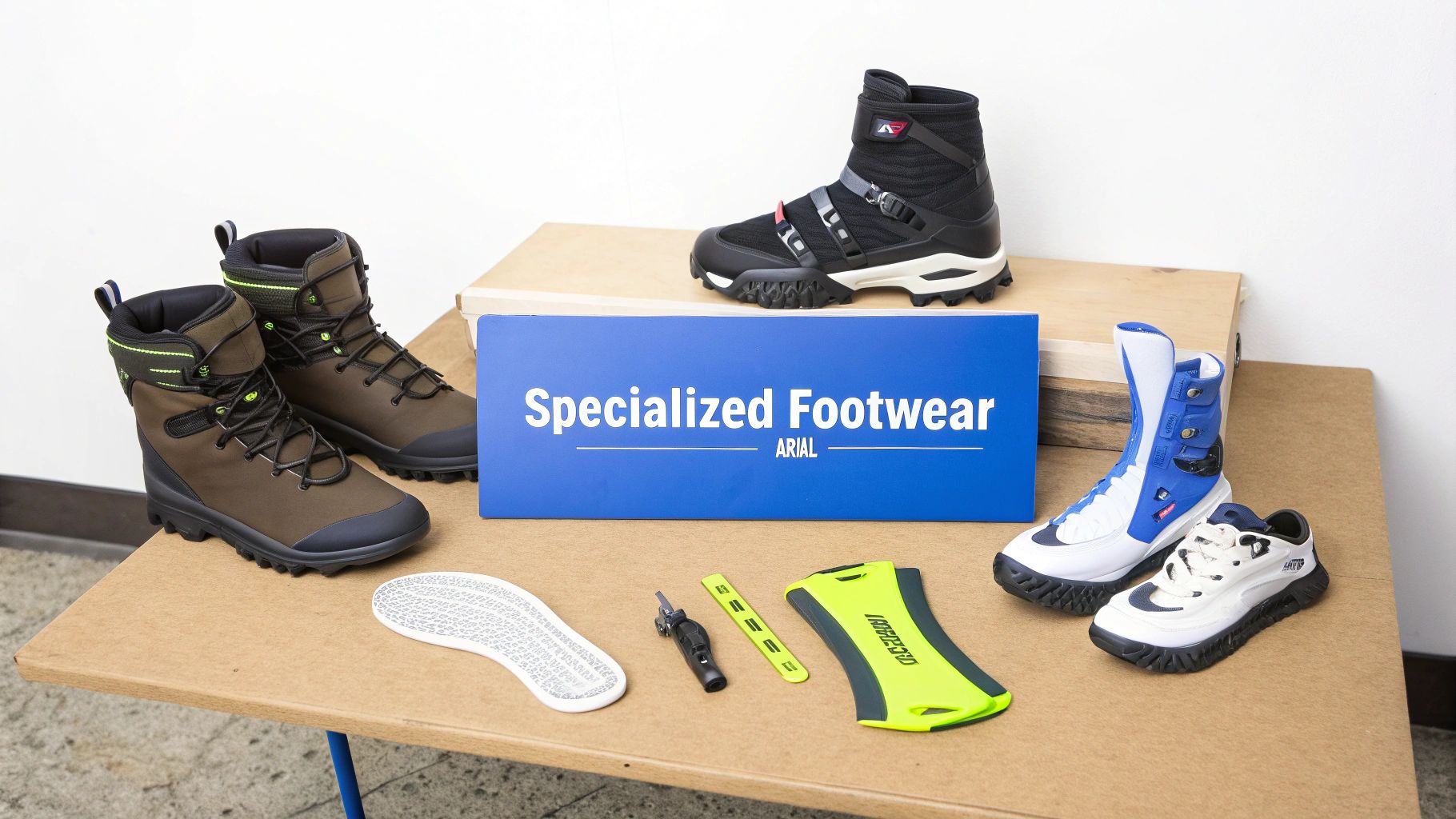
Waterproof Footwear Under Heading 6401
The first specialised category is HS Heading 6401. This heading is reserved for waterproof footwear where both the outer sole and the upper are made of rubber or plastics. The key detail here is how they are put together: the upper must not be fixed to the sole using stitching, riveting, nailing, or any similar method.
Think of items like seamless rubber boots or galoshes. They are primarily designed to keep water out, and their single-mould construction reflects that purpose.
- Example: A pair of classic Wellington boots, moulded from a single piece of rubber, is a perfect fit for heading 6401.
Identifying Dedicated Sports Footwear
This is where things can get tricky. While many athletic-style sneakers will fall under general headings like 6402 or 6404, the HS system has very specific subheadings for footwear designed exclusively for a sporting activity. These aren't your average gym shoes.
This category is for items that have features like spikes, studs, clips, or special attachments. We're talking about football boots with cleats or ski-boots designed to lock into bindings. These features make them completely unsuitable for everyday walking and clearly mark them for a specific sport.
One of the most common errors we see is classifying a high-end running shoe as "sports footwear" in this specialised sense. Unless it has spikes for track and field, it should generally be classified based on its upper and sole material (e.g., 6402 if plastic/rubber or 6404 if textile).
Classifying Footwear Parts and Components
So, what happens when you're shipping shoe parts instead of the finished product? This is exactly what HS Heading 6406 is for. It acts as a catch-all for various footwear components that are shipped on their own.
This heading covers a huge range of items that are essential for shoe manufacturing and repair.
- Uppers and their parts: This is the main body of the shoe, but shipped without a sole attached to it.
- Outer soles and heels: These are the bottom components, made from materials like rubber, plastic, or leather.
- Other components: This bucket covers everything else—removable in-soles, gaiters, leggings, and similar articles.
Classifying these parts correctly is absolutely vital for supply chain and manufacturing logistics. An importer bringing in thousands of rubber soles for a factory must use heading 6406, not a code for finished shoes. Getting the hs code for shoes and their individual components right ensures duties are assessed accurately and your materials move through customs without a hitch.
Navigating HTS Codes and Country-Specific Tariffs
Think of the six-digit HS code as a universal language for identifying footwear around the world. It’s a great starting point, but it's not the full story when it comes to customs clearance. Each country takes this global standard and builds upon it, creating its own Harmonized Tariff Schedule (HTS) by adding extra digits to fit its unique economic policies and regulations. For any freight forwarder, understanding this distinction is crucial.
While the first six digits are the same everywhere, the final two to six digits can change dramatically from one country to the next. These extra numbers, often called statistical subdivisions, are what customs authorities use to apply specific tariff rates, manage trade agreements, and gather detailed import data. This is why a single HS code for shoes can result in very different duty payments depending on where the goods are headed.
Understanding National Variations
A country’s HTS code gives its customs agency the power to set different tariff rates for very specific types of products. For instance, a broad category like "footwear with textile uppers" can be broken down even further. You might find different duties based on whether the shoes are for men, women, or children, or if they have specific features like reinforced toecaps.
This is where paying close attention to the details really matters. If you only use the standard six-digit HS code and don't check the destination country’s full HTS, you're risking inaccurate duty calculations, which means surprise costs for your client and frustrating delays at the border.
The screenshot below, taken from the U.S. Harmonized Tariff Schedule, shows exactly how one general heading gets split into multiple subheadings, each with its own specific code and duty rate.
As you can see, a single footwear category is dissected into much more precise classifications. Each one carries different tariff implications, which really underscores the need for accuracy.
The Impact on Duties and Trade Agreements
Ultimately, the main job of the extended HTS code is to pinpoint the exact duty rate for an imported product. A great example is Singapore's footwear trade under HS 6404.20.60. The general US duty rate for this category is a hefty 37.50%. However, that rate can drop significantly—or even be eliminated—if the goods qualify under a Free Trade Agreement (FTA). You can dive into the specifics and see the financial impact by exploring preferential trade under this specific HTS code.
Getting the hang of the subtle differences between the universal HS code and a country's specific HTS code is what sets an experienced forwarder apart. It allows you to give clients precise quotes, help them take advantage of FTAs, and make sure their shipments clear customs smoothly by catching compliance problems before they happen.
Keeping up with these national tariff schedules isn’t just good practice; it's essential for running a tight operation. For businesses shipping to or from Southeast Asia, knowing the local interpretation of these codes is especially important. For more targeted advice, check out our guide on using the HS code in Singapore. This kind of knowledge is what helps you master the complexities of global trade and deliver real value to your clients.
A Quick Guide to Common Shoe HS Codes
When you're dealing with footwear shipments, getting the classification right from the start saves a massive amount of time. Think of this as your go-to cheat sheet for quickly finding the correct 4-digit HS heading for the most common types of shoes.
It’s designed to help you quickly narrow down the possibilities before you dive into the nitty-gritty of a specific country's tariff schedule. This is the first, and most crucial, step in finding the full HTS code.
Common Footwear Types and Corresponding HS Headings
To help speed up your workflow, we’ve put together a simple lookup table. Just identify the shoe's upper and outer sole materials to find the correct 4-digit HS heading.
| Shoe Type Example | Upper Material | Outer Sole Material | HS Heading |
|---|---|---|---|
| Men's Leather Oxfords | Leather | Rubber / Plastic / Leather | 6403 |
| Canvas Sneakers | Textile (e.g., Canvas) | Rubber / Plastic | 6404 |
| Rubber Flip-Flops | Rubber / Plastic | Rubber / Plastic | 6402 |
| Waterproof Wellingtons | Rubber / Plastic | Rubber / Plastic | 6401 |
| Running Shoes | Plastic / Synthetic Mesh | Rubber / Plastic | 6402 |
| Suede Ankle Boots | Leather (Suede) | Rubber / Plastic | 6403 |
| Fabric Espadrilles | Textile | Rubber / Plastic | 6404 |
| Shoe Uppers (Shipped Alone) | Any (e.g., Leather) | Not Applicable | 6406 |
| Removable Insoles | Any | Not Applicable | 6406 |
This table covers the basics and points you in the right direction. It's the perfect starting point for classifying anything from running shoes to formal leather Oxfords.
Getting the Most Out of This Table
Remember, this reference is your starting point, not the final word. Once you’ve found the right 4-digit heading here, your next job is to look up the complete, country-specific HTS code for your destination.
The first four digits get you into the right category, but the final digits are what really matter for duties. For instance, a men's leather shoe under heading 6403 will likely have a different full HTS code—and a different tariff rate—than a woman's shoe made of the exact same materials. Those details are found at the 8 or 10-digit level in the national tariff schedule.
By starting broad with this table and then drilling down into specifics, you create a solid process that ensures both speed and accuracy for every shipment.
Turning HS Code Data Into Business Opportunities
Understanding the correct HS code for shoes is far more than a simple compliance exercise; it's a real strategic advantage. For freight forwarders, getting the classification right directly helps your clients. It means they pay the correct tariffs and can properly benefit from Free Trade Agreements (FTAs). This level of expertise turns a standard forwarding service into a genuine cost-saving partnership.
But the real game-changer is turning this data outward. HS codes aren't just for declarations—they are incredibly powerful tools for prospecting. By tapping into customs data platforms, you can pinpoint companies that are frequently shipping or importing specific kinds of footwear. Suddenly, a technical code becomes a highly qualified lead list.
Identifying High-Value Footwear Shippers
The whole process starts with a targeted look at the data. Instead of just making generic sales calls, you can filter global trade data for the specific HS codes tied to high-value or high-volume footwear. This data-first approach lets you find the exact companies moving the products you are best equipped to handle.
- Filter by HS Code: You can isolate companies importing large quantities under headings like 6403 (leather footwear) or 6404 (textile footwear).
- Analyse Trade Lanes: Focus your energy on shippers who operate in lanes where you already have competitive rates or specialised services.
- Assess Shipment Volume: Prioritise businesses with consistent, high-volume shipments to make sure your efforts will deliver the best possible return.
This method takes you from cold calling to strategic, evidence-based prospecting. For a deeper look at how to apply these filters effectively, you might be interested in our guide on using an HS code filter for lead generation. A targeted strategy like this ensures you're only spending time on prospects who have a proven need for what you offer.
By transforming customs data into market intelligence, forwarders can stop chasing leads and start attracting them. Knowing a prospect's exact shipping patterns allows you to craft an outreach message that speaks directly to their business needs, showcasing your expertise from the very first interaction.
Crafting Data-Driven Outreach
Once you’ve identified your ideal targets, the next step is to put together a message that resonates. Your knowledge of their specific shipping activity is your most powerful tool. You can directly reference the types of footwear they import, the volumes they handle, and the trade lanes they depend on to show you can add value right away.
For instance, the adoption of detailed HS codes like 6405.20 in Singapore's footwear sector shows its commitment to global standards under Chapter 64. This code covers items like leather-soled trainers and canvas shoes with textile uppers, positioning the city-state as a key compliance hub for regional logistics. For platforms like Coreties, this data allows for precise prospecting by revealing verified contacts for key shippers in these specific footwear lanes. You can learn more about how Singapore's HS codes create logistics opportunities.
Leading with this level of detail proves you’ve done your homework and that you genuinely understand their business. When you open a conversation with insights pulled from their own shipping data, you position yourself not as just another logistics provider, but as a proactive partner who is ready to help optimise their supply chain. It's how a simple compliance detail becomes a powerful engine for business growth.
Common Footwear Classification Mistakes to Avoid
Working with Chapter 64 can be tricky, and even a small slip-up when finding the right hs code for shoes can cause major delays and costly penalties. Getting it right the first time is crucial—misclassification doesn't just snarl up supply chains, it can seriously damage your client's trust. Knowing the common pitfalls is the best way to ensure smooth sailing.
One of the most frequent errors I see is getting the main upper material wrong, especially on shoes made from a mix of materials. The rule itself is simple, but it gets misapplied all the time: you must classify the shoe based on the material covering the largest external surface area. Things like logos, eyelets, or small bits of reinforcement don't count towards this calculation.
Another classic mistake is mixing up everyday, athletic-style trainers with footwear designed for a specific sport.
Misinterpreting Specialised Sports Footwear
From a customs perspective, a high-performance running shoe and a football boot are entirely different animals. Proper sports footwear, which gets classified under specific subheadings like 6402.19 or 6403.19, must have specialised features like spikes, studs, or fixings for attaching equipment such as ski bindings.
Your standard trainers, the kind people wear for a casual run or just as daily fashion, belong under the general headings (6402, 6403, or 6404) based on what they're made of. Classifying a standard sneaker as specialised sports footwear is a surefire way to get a query from customs and a likely reclassification.
Getting detailed product specification sheets from the shipper isn’t just a nice-to-have; it's absolutely essential. These documents give you the exact material breakdown you need to apply the General Rules of Interpretation (GRIs) properly and justify your classification if it's ever challenged.
Overlooking Country-Specific HTS Variations
A huge mistake is thinking the universal 6-digit HS code is enough. It isn't. Importers must use the full 8 to 12-digit Harmonized Tariff Schedule (HTS) code for the destination country, because those extra digits dictate the final duty rate. A single 6-digit HS code can easily branch into several different HTS codes with different tariffs for men's, women's, or children's shoes.
This isn't unique to footwear; you can learn more about how other product categories have similar complexities by reading about the HS code for garments.
Finally, don't forget about footwear parts. Shoe uppers, insoles, or outer soles that are shipped on their own have their own place. They must be declared under heading 6406. If you use a code for a finished shoe, you’ll end up with the wrong duty calculations and a compliance problem. Mastering these distinctions is what separates a smooth customs clearance from a stressful one.
Frequently Asked Questions
When you're classifying footwear, some questions pop up time and time again. Getting the details right can feel tricky, so here are some clear, straightforward answers to the most common queries we see.
How Do I Classify A Shoe With Mixed Materials?
This is a classic problem. What happens when a shoe's upper is a 50/50 split between, say, leather and textile? This is where the General Rules of Interpretation (GRIs) become your best friend.
Specifically, GRI 3(b) is the rule you need. It tells you to classify the shoe based on the material that gives it its "essential character". For footwear, this usually means the material covering the most external surface area. But keep in mind, other factors like the value or specific function of the materials can sometimes influence the final decision.
What's The Difference Between Sports Shoes and Sneakers?
It’s easy to get these confused, but the HS system is very specific here. True "sports footwear" (found in headings like 6402.19 or 6403.19) is purpose-built for a particular athletic activity. Think football boots with cleats, golf shoes with spikes, or cycling shoes with attachments for pedals.
Your typical everyday trainers or fashion sneakers, even if they look sporty, don't fit this definition. They get classified under the standard headings (6402, 6403, or 6404) based simply on the materials of their upper and outer sole, not their athletic style.
Where Can I Find The Official HS Code?
For the most accurate and legally binding information, always go straight to the source: the official customs authority of the country you're importing into.
- Shipping to the United States? The go-to resource is the Harmonized Tariff Schedule (HTS) published by the US International Trade Commission (USITC).
- For other destinations, you'll need to check their national customs website. The World Customs Organisation (WCO) also provides valuable resources.
If you need absolute certainty, the best move is to request a formal binding ruling from the importing country's customs agency. This gives you a definitive classification you can rely on.
Trying to connect with high-volume footwear shippers can feel like searching for a needle in a haystack. Coreties uses global trade data to build targeted lead lists, putting you in touch with the right decision-makers in just a few clicks. Find qualified prospects and create data-driven outreach at https://coreties.com.